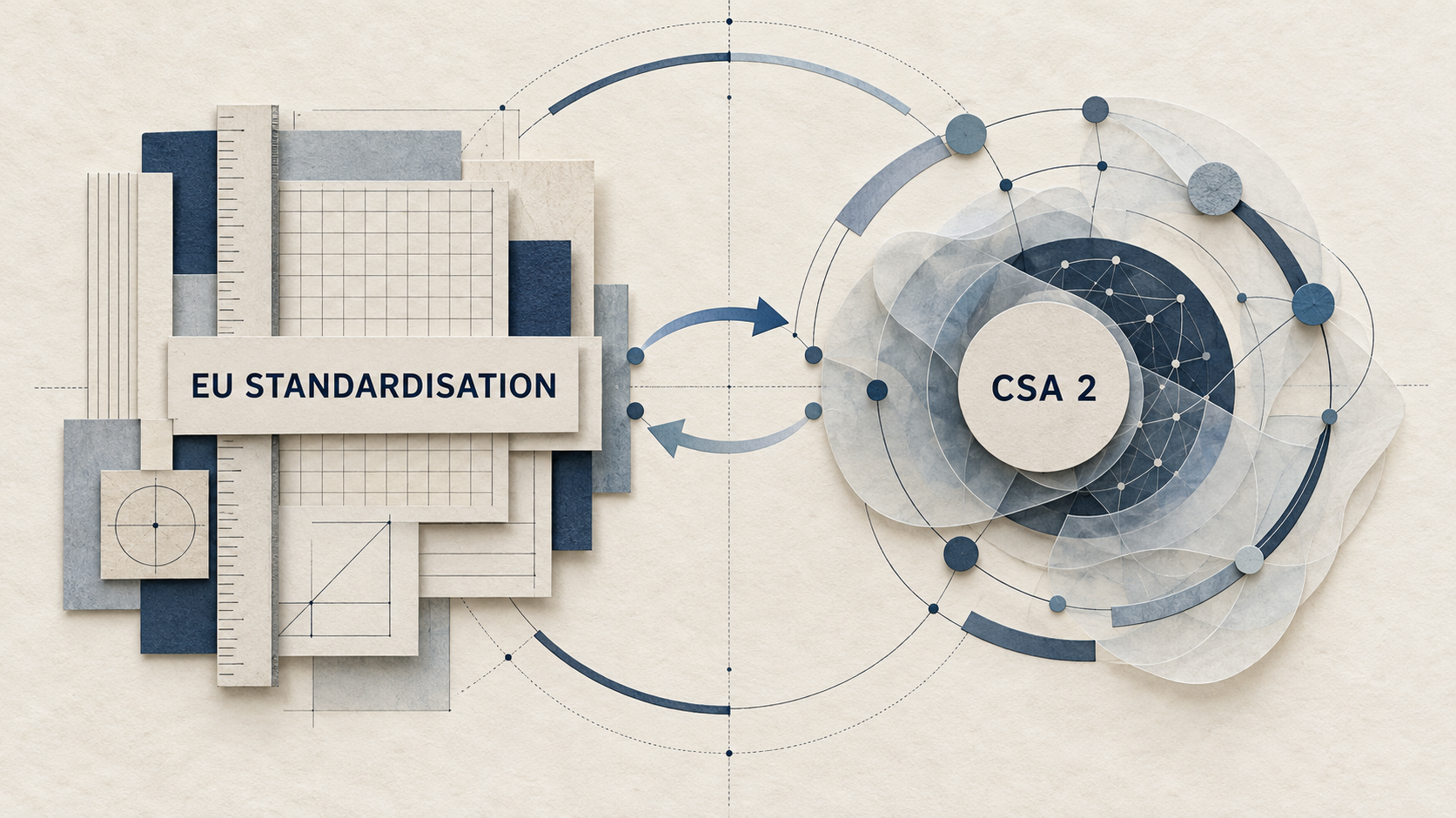
The European Commission presents its proposal for a new Standardisation Regulation as a pragmatic response to a familiar problem: European standards are sometimes delivered too slowly to keep pace with legislation and technological change. One could argue that robust standards require time and expertise, the EU executive choise is slightly different and is making the case for greater speed and agility. But at what cost?
CEN, CENELEC and ETSI would remain central, but the Commission could request standards from other designated standards development organisations, potentially including international industry fora and consortia.
This raises two related questions. Could the proposal create a parallel regulatory standardisation channel and new barriers to market entry? An what public accountability should apply when privately developed standards and deliverables acquire regulatory effects through publication in the Official Journal?
A new route to regulatory recognition
Under Articles 26 to 31, the Commission could designate a non-ESO organisation, address a standardisation request to it and subsequently publish the reference of the resulting document in the Official Journal.
Where the relevant legislation confers a presumption of conformity, a standard produced through this route would qualify as a harmonised standard. It could therefore obtain the same regulatory effects as one developed by an ESO, although it would not constitute a “European standard” within the institutional meaning of the proposal.
The organisation would first have to satisfy the criteria in Articles 26 and 27. Its designation and the request addressed to it would be adopted under the examination procedure, providing Member State scrutiny through comitology.
The technical content would nevertheless be developed and adopted according to the organisation’s own governance. Unlike the ESO route, the relevant decisions would not necessarily be taken by representatives of EU and EEA national standardisation bodies.
Comitology would therefore provide public control over the choice of organisation and the scope of its mandate. It would not reproduce the continuous involvement of national technical experts in developing and adopting the document.
Outside the Vienna and Frankfurt frameworks
The Vienna Agreement coordinates the work of CEN and ISO, while the Frankfurt Agreement performs a comparable function between CENELEC and IEC. These frameworks provide for common planning, technical cooperation, parallel voting and, where appropriate, the adoption of identical European and international standards.
ETSI has also developed partnerships and technical cooperation arrangements with ISO, IEC and ITU. However, these arrangements do not establish the same systematic mechanisms for parallel development, voting and adoption.
Neither set of mechanisms would automatically apply to documents developed by designated organisations outside the ESO framework.
The proposal does introduce safeguards, but are they sufficient? Article 35 establishes an “international first” principle, requiring both ESOs and designated organisations to use an existing or forthcoming international standard as a basis, unless the Commission considers it ineffective or inappropriate for the legitimate objective pursued. Article 29 also allows the Commission to impose specific requirements concerning cooperation with international standardisation bodies.
Under Article 28, a designated organisation must provide its draft to an ESO upon request. The ESO may then comment on its coherence with standards and deliverables already referenced in the Official Journal. The designated organisation must take those comments into account and reply, but it is not required to follow them. This is a consultation mechanism. It does not provide the same level of scrutiny, national participation or technical coordination as the established ESO system.
These safeguards are intended to promote alignment, but they do not reproduce the existing institutional mechanisms. Using an international standard “as a basis” does not guarantee interoperability, coordinated technical work, parallel voting or the adoption of identical standards. It encourages technical alignment without ensuring institutional convergence.
A recognised barrier to participation
Companies may need to follow several standardisation ecosystems simultaneously. A business already participating in an ESO through its national body may also need to monitor or join the forum selected to produce a document that could become the preferred regulatory route.
The Commission’s impact assessment expressly recognises that companies may have to duplicate their investments in standardisation to participate both in ESOs and alternative SDOs.
It acknowledges that these costs could represent “a relatively higher barrier to participation for SMEs and Annex III organisations”.
The Commission estimates an upper-bound additional cost of EUR 4.5 million per year for businesses, assuming that no more than 10% of requests would follow the alternative route. It also reports that 61% of responding businesses opposed opening requests to alternative organisations, even where balanced participation was required. Impact Assessment SWD(2026) 786, pp. 38-39
The SME test further notes that SMEs active within an ESO could lose influence when work moves to another organisation and incur additional participation costs. SME representatives were not fully confident that alternative SDOs would provide the same level of inclusiveness. Impact Assessment, pp. 119-120
A barrier to participation is therefore not merely hypothetical. It is recognised in the Commission’s own analysis.
From participation barrier to market entry barrier
Recital 7 of the proposed Regulation expressly recalls that compliance with harmonised standards is not compulsory. Manufacturers may therefore demonstrate compliance by other technical means. This principle is also recognised by the Court of Justice. At the same time, the Court considers that harmonised standards form part of EU law because of their legal effects, notably the presumption of conformity they confer. See James Elliott, C-613/14 and Public.Resource.Org, C-588/21 P. Formal voluntariness should therefore not be confused with regulatory or economic neutrality.
The Cyber Resilience Act illustrates this distinction. Under Article 32, a manufacturer of an important class I product that does not fully apply the relevant harmonised standards, common specifications or recognised certification schemes cannot rely on internal control alone. It must use EU type examination followed by conformity to type, or a full quality assurance procedure involving a notified body. Cyber Resilience Act, Article 32 and recital 91
Accreditation does not formally require a notified body to favour a particular product standard. However, an harmonised standard provides the most familiar, reproducible and legally secure benchmark. It is recognised by notified bodies, accreditation authorities and market surveillance authorities. A manufacturer relying on another solution must provide more extensive evidence, while the notified body must conduct a more individualised assessment and assume greater responsibility for its conclusions. This can increase costs, delays and legal uncertainty.
A standard may therefore remain voluntary in law while becoming almost unavoidable in economic and operational terms.
If the relevant document is developed within a designated private consortium, limited influence over its content, participation costs and restrictions affecting the underlying technology could turn a barrier to participation in standardisation into a de facto barrier to market entry.
The consequence could be a less accessible and more concentrated market, favouring companies able to influence private standardisation processes and absorb the costs of alternative conformity assessment. It could also create technological lock in, reinforce strategic dependencies and weaken effective competition, particularly for SMEs and new entrants.
Standard-essential patents, cartel risks and sovereignty
The proposal guarantees free access to referenced standards, but does not establish uniform requirements on patent disclosure, essentiality checks, aggregate royalties or FRAND licensing.
This gap is particularly relevant following the Commission’s formal withdrawal in October 2025 of its proposed Regulation on standard-essential patents. That initiative would have created an EU register, essentiality checks, greater royalty transparency and mechanisms supporting FRAND determination. COM(2023) 232—withdrawn on 6 October 2025
Standardisation cooperation is not inherently anticompetitive. However, where a limited group of companies influences the technologies incorporated into a standard, competition concerns may arise. Consortium members could favour technologies covered by their own patent portfolios, obtain an information or time-to-market advantage, or impose cumulative licensing costs on competitors.
If participation and access to essential technologies are not genuinely open and non-discriminatory, the process could facilitate coordinated foreclosure or produce cartel-like effects.
There is a sovereignty dimension. A document developed by a non-EU organisation could acquire regulatory effects in the Single Market while depending on technologies and patent portfolios controlled predominantly by non-EU actors.
This could reinforce strategic dependencies precisely where the Union seeks to strengthen technological sovereignty and economic security.
The question is therefore not only who writes the standard, but who controls the technologies embedded in it.
When private documents become part of EU law
These concerns matter because harmonised standards (and by extension harmonised standards developepd through private for a and corsotia) are not merely private technical documents.
In James Elliott Construction, the Court of Justice held that a harmonised standard whose reference is published in the Official Journal forms part of EU law. Although developed by a private organisation, it constitutes a necessary implementation measure governed by requirements laid down in Union legislation and initiated, managed and monitored by the Commission. Case C-613/14, paragraphs 40-43
In Public.Resource.Org, the Grand Chamber confirmed that harmonised standards form part of EU law because of their legal effects and may specify individuals’ rights and obligations. The Court linked this conclusion to the rule of law, transparency and free access to EU law. Case C-588/21 P, paragraphs 70 and 80-83
A harmonised standard is not a legislative act. But once cited, it is no longer only a private market document: it becomes part of the practical content of EU law. the question is no longer purely technical. It concerns the conditions under which private rulemaking acquires effects within EU law, and whether the resulting framework provides sufficient public oversight, representation and accountability.
What about accountability and where are the Member States?
In 2022, the Parliament and Council reinforced the national dimension of European standardisation. Regulation (EU) 2022/2480 requires decisions within ESOs concerning Commission requested standards to be taken exclusively by representatives of national standardisation bodies from the EU and EEA. Its recitals identify these bodies as best placed to safeguard Union interests, public policy objectives and European values. Regulation (EU) 2022/2480, recitals 4 to 8
This safeguard would remain within the ESO route, but would not be reproduced in the same form for designated fora and consortia. Member States would scrutinise key Commission decisions, including the designation of an organisation and the standardisation request, through the examination procedure. The designated private organisation would nevertheless develop and adopt the technical content according to its own governance rules.
Comitology provides political and legal oversight, but it is not equivalent to the continuous involvement of national standardisation bodies and their technical experts.
The question is whether scrutiny of Commission implementing acts can adequately compensate for the absence of comparable technical national participation and final validation in drafting, adopting and revising documents that may subsequently produce significant effects under EU law.
Privatising regulatory norm-setting?
The more precise concern is the potential privatisation of a norm-setting function producing significant regulatory and market-access effects.
The model remains legally defensible where the legislator determines the essential requirements, the standard only specifies technical means of compliance, alternative routes remain genuinely accessible, and the Commission and the Member States exercises their effective control.
The concern becomes more serious where a standard effectively determines operators’ obligations, alternative compliance routes are economically unrealistic or its development is dominated by a limited group of market participants. They are already observable, to varying degrees, across today’s standardisation landscape.
Article 290 TFEU reserves the essential elements of an area to the legislative act. Neither the Commission nor a private organisation should determine those essential political choices. The greater a standard’s influence over market access, the more important it becomes to ensure that it remains within a strictly technical mandate.
A foreseeable and not inevitable outcome?
The proposal does not per se create a legal barrier to market entry or amount to an unlawful delegation of legislative power. It includes safeguards concerning designation, Member State scrutiny through comitology, transparency, international alignment, coherence and free access. However, the practical effects of the system will ultimately depend on how these safeguards are implemented. Market realities may prove less reassuring than the legal framework suggests.
Nevertheless, a parallel regulatory standardisation channel is a foreseeable outcome.
Faster standards may be necessary. But once a privately developed document acquires regulatory effects and influences the practical conditions of market access, speed cannot be assessed separately from legitimacy, competition and technological sovereignty.